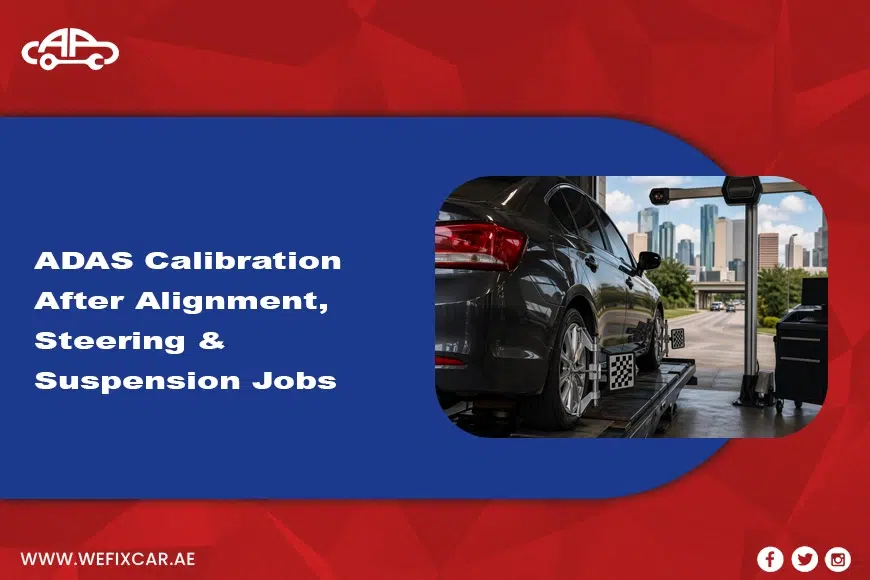
Modern vehicles use advanced driver assistance systems (ADAS) to support drivers with features such as lane departure warnings, adaptive cruise control, forward collision alerts, and automatic emergency braking. Because these systems depend on sensors and cameras positioned around the vehicle, even a small change in wheel angles or suspension components can affect their accuracy. This is why drivers searching for wheel alignment and balance near me in Dubai should also understand when ADAS calibration may be necessary after alignment, steering, or suspension work.
What Is ADAS Calibration?
ADAS calibration is the process of checking and adjusting the cameras, radar sensors, and other components used by a vehicle’s driver assistance systems.
Depending on the vehicle, ADAS may include:
- Lane departure warning
- Lane keeping assistance
- Adaptive cruise control
- Forward collision warning
- Automatic emergency braking
- Traffic sign recognition
- Blind spot monitoring
- Parking assistance
- Surround-view camera systems
These systems rely on precise measurements. If a sensor is slightly out of position, the vehicle may not interpret its surroundings correctly.
Calibration helps ensure that the system’s sensors and cameras are positioned and aligned according to the vehicle manufacturer’s specifications.
Why Wheel Alignment Can Affect ADAS
Wheel alignment and ADAS may seem like separate services, but they can be closely connected.
Wheel alignment involves adjusting the angles of the wheels so they are correctly positioned relative to the vehicle and the road. The main alignment measurements generally include camber, caster, and toe.
When these angles change, the vehicle’s direction and steering position can also change.
ADAS systems such as lane keeping assistance may use steering angle information and camera data to understand the vehicle’s position within a lane. If the steering wheel is no longer centered after an alignment or if suspension geometry has changed, the ADAS system may require calibration.
This does not mean every wheel alignment automatically requires ADAS calibration. The requirement depends on the vehicle, the work performed, the ADAS system, and manufacturer specifications.
What Happens During a Wheel Alignment?
During a professional wheel alignment, technicians inspect the vehicle and measure the wheel angles using specialized equipment.
A typical alignment service may involve:
- Inspecting steering and suspension components
- Checking tire condition and pressure
- Measuring wheel alignment angles
- Comparing measurements with manufacturer specifications
- Adjusting the relevant components
- Checking the steering wheel position
- Performing a final measurement
If the alignment involves changes that can affect an ADAS system, the vehicle may also need a calibration procedure.
Steering Repairs Can Require ADAS Calibration
Steering-related repairs can sometimes affect systems that depend on steering angle or vehicle direction.
For example, work involving the steering rack, steering linkage, tie rods, or steering angle sensor may change the relationship between the steering wheel and the vehicle’s actual direction.
After certain steering repairs, technicians may need to perform a steering angle reset or calibration. In some vehicles, additional ADAS calibration may also be required.
The exact procedure varies between manufacturers and vehicle models.
A professional workshop should therefore check the manufacturer’s requirements rather than assuming that a standard scan or reset is sufficient.
Suspension Work and ADAS
Suspension components help determine the vehicle’s ride height, wheel position, and handling characteristics.
Replacing or repairing components such as:
- Control arms
- Ball joints
- Tie rods
- Shock absorbers
- Struts
- Steering components
- Suspension links
can potentially change wheel geometry.
Even if the vehicle feels normal after the repair, the alignment measurements may have changed. If the vehicle is equipped with ADAS, technicians should determine whether the repair also affects the calibration requirements for the vehicle’s sensors or cameras.
This is especially important when suspension work changes the vehicle’s ride height or the position of components used as references by ADAS systems.
Read More: Wheel Alignment & Balancing: Why Does It Really Matter?
Why ADAS Calibration Matters After Alignment
ADAS features are designed around precise vehicle movement and positioning.
Consider a forward-facing camera that helps identify lane markings. If the vehicle’s steering geometry changes significantly, the relationship between the camera’s view and the vehicle’s direction can also change.
Similarly, radar-based systems depend on accurate positioning and angles.
Incorrect calibration could result in:
- Warning messages
- Incorrect lane detection
- Delayed or unnecessary alerts
- ADAS features becoming unavailable
- Driver assistance systems operating outside their intended parameters
The purpose of calibration is not to make the vehicle’s system more sensitive. It is to ensure that the system is operating according to the vehicle manufacturer’s specifications.
Static vs. Dynamic ADAS Calibration
ADAS calibration procedures can generally involve static calibration, dynamic calibration, or a combination of both.
Static Calibration
Static calibration is usually performed in a workshop using specialized equipment and carefully controlled measurements.
The vehicle may need to be positioned on a level surface. Calibration targets are placed at specific distances and angles according to manufacturer instructions.
The technician then uses diagnostic equipment to calibrate the relevant camera or sensor.
Dynamic Calibration
Dynamic calibration involves driving the vehicle under specified conditions so that the system can calibrate while observing real-world road information.
The exact driving conditions vary by vehicle manufacturer and system.
Some vehicles may require both static and dynamic procedures.
How Wheel Balancing Differs From Wheel Alignment
Wheel balancing and wheel alignment are often mentioned together, but they address different problems.
Wheel alignment focuses on the angles and positioning of the wheels.
Wheel balancing addresses the distribution of weight around the wheel and tire assembly.
An unbalanced wheel can cause vibrations, particularly at certain speeds. Alignment problems can contribute to uneven tire wear, steering issues, or the vehicle pulling to one side.
Neither service should automatically be treated as an ADAS calibration procedure. However, both may be part of a broader vehicle inspection when a driver experiences steering or handling problems.
Signs Your Vehicle May Need an Alignment Check
Drivers in Dubai should pay attention to changes in vehicle handling.
Possible signs of an alignment problem include:
- The vehicle pulls to one side
- The steering wheel appears off-center
- Tires wear unevenly
- The vehicle feels unstable
- The steering does not return normally after a turn
- The vehicle’s handling feels different after suspension work
These symptoms do not prove that ADAS calibration is required. They indicate that the vehicle should be inspected to identify the underlying issue.
Signs That ADAS May Need Attention
Some vehicles display a warning when an ADAS component requires calibration or becomes unavailable.
Depending on the vehicle, drivers may notice:
- ADAS warning lights
- Lane assist becoming unavailable
- Adaptive cruise control warnings
- Camera or radar system messages
- Forward collision warning system errors
- Driver assistance features switching off
A dirty camera or sensor, damaged component, software issue, or calibration problem can contribute to these warnings.
Technicians should diagnose the specific cause rather than assuming that calibration alone will solve the issue.
Why Dubai Drivers Should Take These Services Seriously
Dubai has a wide range of road conditions, from busy urban streets to high-speed highways. Vehicles may also experience significant heat exposure, which makes regular vehicle inspections important.
Alignment problems can develop after hitting potholes, curbs, road debris, or other obstacles. Suspension components can also wear over time.
When steering, suspension, or alignment work is performed on a vehicle equipped with ADAS, it is useful to ask whether the manufacturer’s calibration procedure applies.
This simple question can help ensure that necessary post-repair procedures are not overlooked.
What to Ask a Workshop Before ADAS Calibration
Before approving the work, drivers can ask the technician several practical questions.
Does My Vehicle Need ADAS Calibration?
Not every vehicle requires calibration after every alignment or suspension repair. The technician should determine this based on the vehicle’s system and the work performed.
Which ADAS System Is Being Calibrated?
Ask whether the procedure involves a front camera, radar sensor, surround-view camera, steering angle sensor, or another component.
Is the Calibration Static or Dynamic?
The vehicle manufacturer determines the required procedure. Some systems require specific calibration methods.
Is a Wheel Alignment Required First?
For some ADAS systems, the vehicle must have correct alignment before calibration can be completed accurately.
Will You Provide a Calibration Report?
Documentation can provide useful information about the procedure performed and whether the system passed the relevant checks.
Finding the Right Wheel Alignment Service in Dubai
When searching for wheel alignment and balance near me, it is useful to consider more than location.
Look for a workshop with suitable alignment equipment, trained technicians, diagnostic capabilities, and experience with modern vehicles.
If your vehicle has ADAS, ask whether the workshop can diagnose and calibrate the relevant systems or whether it works with a specialist calibration facility.
A workshop that understands the relationship between alignment, steering, suspension, and ADAS can help identify whether additional procedures are necessary.
Can ADAS Calibration Be Done Without Alignment?
In some situations, ADAS calibration may be possible without performing an alignment. However, this depends on the vehicle and the reason calibration is required.
If the vehicle’s wheel alignment is outside manufacturer specifications, performing ADAS calibration before correcting the alignment may not produce the desired result.
For this reason, technicians should follow the vehicle manufacturer’s service procedure.
How Often Should ADAS Calibration Be Done?
There is no universal interval that applies to every vehicle.
ADAS calibration may be required after specific repairs or events rather than according to a fixed mileage schedule.
Possible triggers can include:
- Front-end collision repairs
- Windshield replacement
- Steering repairs
- Suspension repairs
- Wheel alignment
- Changes affecting vehicle ride height
- Camera or radar replacement
- Sensor removal or repositioning
- Certain body repairs
The vehicle manufacturer’s service information should be used to determine whether calibration is required.
The Importance of Manufacturer Specifications
ADAS technology differs significantly between manufacturers and vehicle models.
A calibration procedure suitable for one vehicle may not be suitable for another. The required target position, measurement distance, diagnostic equipment, driving conditions, and calibration sequence can vary.
This is why professional ADAS work should be performed using the appropriate manufacturer information and equipment.
A generic approach may not be sufficient for every vehicle.
Final Thoughts
Wheel alignment, steering repairs, suspension work, and ADAS calibration can be connected because all of these systems influence how a vehicle moves and how its driver assistance technology interprets that movement. When looking for wheel alignment and balance near me in Dubai, drivers with modern vehicles should ask whether their recent repair or alignment work has any ADAS calibration requirements.
Not every alignment or suspension repair requires calibration, but certain procedures can affect sensors, cameras, steering angle information, or vehicle geometry. Checking the manufacturer’s requirements can help ensure that important post-repair procedures are completed correctly.
For Dubai drivers, choosing a workshop with proper alignment equipment, diagnostic capabilities, and knowledge of ADAS procedures can make vehicle maintenance more comprehensive. The goal is to ensure that the mechanical systems and electronic driver assistance features are both operating according to the vehicle manufacturer’s specifications.
Frequently Asked Questions
1. Does wheel alignment affect ADAS?
It can. Changes in wheel alignment and steering geometry may affect certain ADAS systems, depending on the vehicle. The manufacturer determines whether calibration is required after specific alignment work.
2. Is ADAS calibration required after suspension repair?
It may be required after certain suspension repairs, particularly when the repair changes vehicle geometry or ride height. The vehicle manufacturer’s service procedure should be checked.
3. Does every wheel alignment require ADAS calibration?
No. ADAS calibration is not automatically required after every alignment. The requirement depends on the vehicle, ADAS technology, and work performed.
4. What is the difference between wheel alignment and wheel balancing?
Wheel alignment corrects the positioning and angles of the wheels, while wheel balancing corrects uneven weight distribution in the wheel and tire assembly.
5. When should ADAS be calibrated?
Calibration may be required after certain collisions, windshield replacements, steering or suspension repairs, wheel alignment, sensor replacement, or other work that affects ADAS components.
6. Can a warning light indicate an ADAS calibration problem?
It can. Some vehicles display warnings when an ADAS camera, radar sensor, or related system requires attention. A diagnostic inspection is needed to determine the actual cause.
7. Should alignment be done before ADAS calibration?
For some vehicles, correct wheel alignment is part of the required conditions for ADAS calibration. The appropriate sequence depends on the manufacturer’s procedure.
8. Where can I find wheel alignment and balancing services in Dubai?
When searching for a suitable workshop, consider its alignment equipment, diagnostic capabilities, technician experience, and ability to handle vehicles equipped with modern ADAS technology.