You’re driving home along a road you’ve taken a hundred times, and a pothole you didn’t quite see in time sends a jolt through the whole car. A week later, something feels off. The ride’s bouncier on the highway. There’s a faint knock over speed bumps. The car seems to sit a little crooked when it’s parked.
That’s your suspension talking, and in Dubai it tends to speak up sooner than in most places. Between speed bumps that show up every hundred metres, the odd pothole on older stretches of road, and summer asphalt that can push past 45°C, the rubber bushings and seals in a suspension system here dry out and crack years before a car in a cooler climate would show the same wear.
So, can you actually change your car’s suspension? Yes, and in most cases, you don’t need to replace the whole thing. Below is a straightforward look at the real signs your suspension is wearing out, the main types of car suspension systems you’re likely to come across, whether a full system replacement ever actually makes sense, and what suspension replacement tends to cost once you’re sitting across from a technician with a quote in hand.
How Do You Know Your Suspension Is Wearing Out?
Suspension wear rarely announces itself all at once. It creeps in a millimetre at a time, which is exactly why most drivers only notice once the ride has gotten properly uncomfortable, or something starts sounding wrong.
A few things worth paying attention to: the car keeps bouncing once or twice after you’ve already cleared a bump, instead of settling straight away. It dips forward noticeably under hard braking, or leans more than it used to through a roundabout. One corner sits visibly lower than the others when the car’s parked on flat ground. There’s a clunk, knock, or creak from underneath, especially over speed bumps. Tyres are wearing unevenly, or the car drifts slightly to one side on a straight, flat road.
Any single item on that list isn’t necessarily a crisis. A couple of them turning up together, though, is a fair sign that something specific needs a proper look. We’ve gone into the usual causes of suspension failure in more detail elsewhere, but age, hard impacts from potholes, and corrosion cover most of it, and none of those tend to fix themselves.
If you’re not sure whether what you’re feeling is normal wear for an older car or an actual fault, it’s worth getting it checked rather than guessing. Catch it early, and the fix is almost always simpler and cheaper.
The Main Types of Car Suspension Systems
Not every car handles a bump the same way, and that comes down to which suspension system it’s built around. Knowing the different types of car suspension systems isn’t just trivia, it affects how a car rides, how expensive repairs tend to be, and sometimes what your options even are when something needs fixing.
MacPherson strut is what you’ll find under most everyday hatchbacks and sedans. It folds the shock absorber and spring into one compact unit, which keeps things simple, light, and relatively cheap to repair, a big part of why it’s everywhere.
Double wishbone setups use two wishbone-shaped arms to control how the wheel moves more precisely, keeping the tyre flatter against the road through corners. You’ll usually find this on cars built with handling in mind.
Multi-link suspension takes that idea further still, using several separate arms and linkages rather than one or two. It costs more to build and more to fix, but it tends to deliver a noticeably smoother, better-controlled ride, which is why it’s common on modern sedans and SUVs.
Torsion beam suspension is simpler and cheaper, usually sitting on the rear axle of smaller, budget-friendly cars. It won’t win any handling contests, but it’s reliable and inexpensive to keep running.
Leaf spring suspension is the old workhorse, stacks of curved metal strips built to carry serious weight. These days you’ll mostly find it on trucks, vans, and older four-wheel-drives rather than ordinary passenger cars.
Then there’s air suspension, increasingly common on luxury SUVs and high-end sedans, using air-filled bags instead of steel springs. It rides beautifully and lets you adjust height and stiffness, but it’s also the most complex system here, and by far the most expensive to put right when something fails.
Knowing which one your car actually has is a useful first step before any conversation about repairs, since the type you’re dealing with has a real effect on both the diagnosis and what it costs to fix.
So, Can You Actually Replace the Whole Suspension System?
Technically, yes. Practically, it’s rarely necessary.
Most of the time, a mechanic won’t condemn the entire suspension, they’ll inspect it, find the one or two components that have genuinely failed, and replace just those. It’s cheaper, quicker, and means you’re not paying for parts that still had plenty of life left.
A full suspension system replacement, in Dubai or anywhere else in the UAE, tends to come up in a narrower set of situations: after a serious accident that’s damaged several components at once, on a car with very high mileage where everything’s wearing out around the same time, or when someone’s deliberately upgrading, say fitting performance dampers.
One rule worth knowing regardless: if a shock or spring on one side needs replacing, it’s generally best to do both sides of that axle together, not just the one that failed. Mismatched components on the same axle can throw off the car’s balance, even if the old one still seems fine.
So the honest answer to whether you can change your car suspension repair is: absolutely, just let a proper inspection decide how much of it actually needs changing.
What Does Suspension Replacement Cost in Dubai?
This is usually the question that actually gets people picking up the phone, so let’s talk real numbers, while keeping in mind that every quote depends on the specific car repairs and what’s actually gone wrong.
For a standard set of shock absorbers, expect somewhere around AED 800 to 1,500 per pair. Struts tend to run a bit higher, typically AED 1,500 to 3,000 per pair. Smaller individual parts like ball joints or bushings are usually cheaper on their own, often a few hundred dirhams each, though labour adds up quickly if several need doing at once.
Coil springs generally land around AED 700 to 1,500 apiece, or roughly AED 2,500 to 4,000 for a full set. Where it gets genuinely expensive is air suspension: a single air spring can run AED 2,500 to 4,500, and a full system overhaul on a luxury SUV can reach anywhere from AED 12,000 well past AED 20,000.
A handful of things move that price around in practice. The car itself matters, since European and luxury models generally cost more to service than mainstream options, sometimes by a wide margin. Parts quality matters too: genuine or OEM parts cost more upfront than aftermarket equivalents, though they tend to last longer. Where you take it matters, since pricing varies noticeably between a dealership, an independent garage, and mobile repair options. And how much actually needs fixing matters most of all, since one worn bushing is a very different bill from four corners’ worth of failed parts.
None of this replaces an actual inspection. Treat these ranges as a way to sanity-check a quote rather than a substitute for getting one, and if a number seems wildly out of step with what’s here, it’s fair to ask why.
What Actually Happens During the Repair
If you’ve never had suspension work done, the process is fairly simple from where you’re sitting.
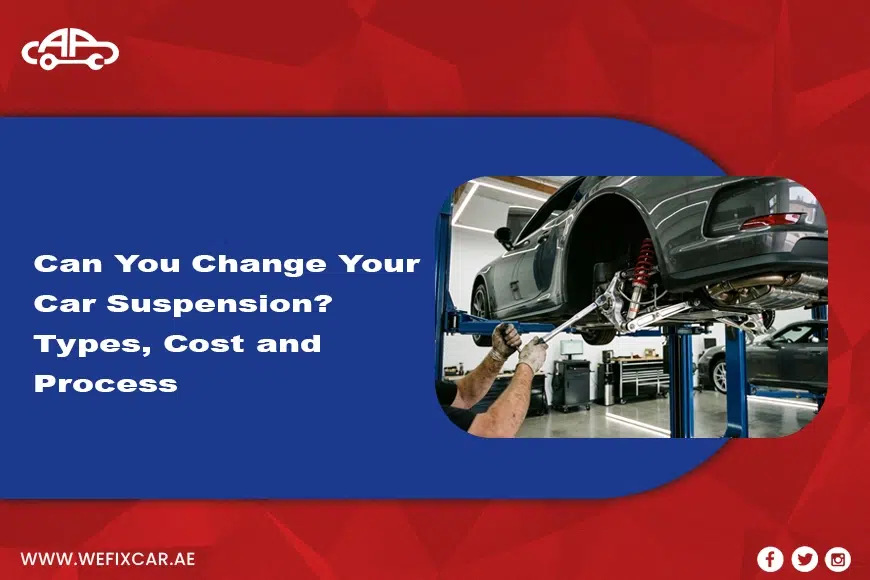
It usually starts with a proper inspection and a short test drive, so the technician can actually feel what you’ve been describing rather than going off words alone. From there, the car’s lifted, the wheels come off, the worn parts come out, and the new ones go in, matched in pairs across an axle, for the reasons mentioned earlier. The last step, and arguably the most important one, is a wheel alignment check, since new suspension parts sitting even slightly out of alignment will wear unevenly and ride poorly almost immediately.
As for timing: a standard set of shocks is usually a two-to-four-hour job, with struts adding roughly another hour. If it turns out to be more extensive, several components across the car, or something closer to a full suspension system replacement, budget for the better part of a day, sometimes eight to twelve hours once everything’s accounted for.
It’s not a job worth rushing, either as a driver trying to save time or a technician trying to clear the bay faster. A suspension reassembled carelessly is arguably more dangerous than one that’s simply old.
Final Thoughts
So, can you change your car’s suspension? Yes, but the more useful question is which part of it actually needs changing, and that’s not something to guess at from the driver’s seat.
If any of the signs above sound familiar, a bouncier ride, an odd clunk, a car that sits a little crooked, it’s worth getting looked at sooner rather than later. Suspension problems don’t fix themselves, and the parts around a worn component tend to wear out faster too, which is how a two-hundred-dirham bushing turns into a much bigger bill if it’s left for a year.
A proper car suspension repair starts with an honest inspection rather than a guess, since that’s really the only way to know whether you’re dealing with one part or several. If getting to a workshop is the inconvenient bit, mobile auto repair in Dubai can come to wherever the car actually is, which is often the simplest way to get a second opinion without losing half your day. And for anything beyond the suspension itself, the full range of car repairs on offer is worth a look too.
Either way, a smoother, safer ride is usually closer and cheaper, than most people expect.
Frequently Asked Questions
How much does car suspension replacement cost in Dubai?
It depends entirely on what needs replacing and what you drive. A single pair of shocks might run a few hundred dirhams up to around AED 1,500, while a full air suspension overhaul on a luxury SUV can reach well into five figures. The only way to get a real number is an inspection.
Can you replace the entire suspension system of a car?
You can, but it’s rarely needed. Most cars only need the specific worn parts replaced rather than a full system swap, which tends to get reserved for serious accident damage, very high mileage, or a deliberate upgrade.
How do I know if my car suspension needs replacing?
Watch for excessive bouncing after bumps, nose-diving under braking, a car that leans to one side when parked, knocking noises over speed bumps, or tyres wearing unevenly. Two or more of these together is worth getting checked properly.
How long does it take to replace a car suspension?
A standard set of shocks usually takes two to four hours; struts add a little more. More extensive jobs covering several components can take the better part of a day, including the alignment check that follows.
What are the different types of car suspension systems?
The main ones are MacPherson strut, double wishbone, multi-link, torsion beam, leaf spring, and air suspension, each with its own balance of comfort, cost, and complexity, as covered above.