

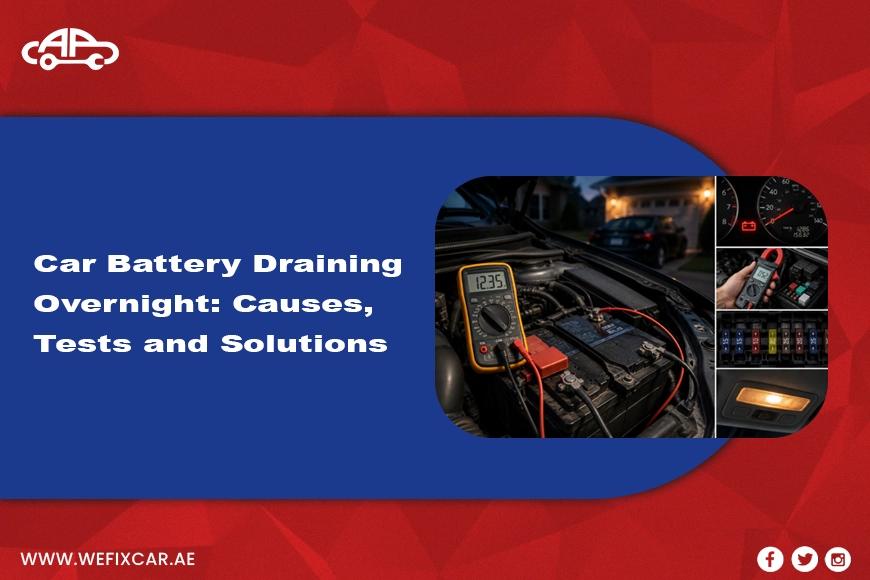
You park the car in the evening and it starts perfectly. By morning, the dashboard is dark, the engine clicks and you’re calling for a jump start. If that keeps happening, the problem usually isn’t bad luck. Something is quietly using power while the car is off, or the car battery can no longer hold a charge.
This guide explains why a battery can go flat overnight, how to run a parasitic battery drain test and what to do about each cause. It’s a common problem in Dubai’s summer heat, and it’s rarely as expensive to fix as it feels at 7am. You can do most of the early checks yourself with a basic multimeter and a little patience.
Why Does My Car Battery Keep Dying?
There are three usual explanations:
- Something drains it while parked: A parasitic drain from a light, a module or an accessory
- The battery is worn out: It no longer holds enough charge, which is common after two to four years in Dubai’s heat
- The charging system isn’t recharging it: A weak alternator or loose connections mean the battery never fills up
A new battery can still go flat if the real cause is a drain or a charging fault, so find the cause before you buy anything. Regular testing catches all three early, and you can see what a Car Service at Home visit includes for electric and petrol cars.
Car Battery Draining Overnight: What’s Normal and What Isn’t
Every modern car uses a little power when it’s off, for the clock, the alarm and the computer memory. That’s normal. Once all the modules go to sleep, most cars draw roughly 20 to 50 milliamps, and some modern cars settle slightly higher, up to around 85 milliamps. A draw above about 100 milliamps is suspicious, and a few hundred milliamps will flatten a healthy battery overnight.
How Fast Can a Parasitic Drain Flatten a Battery?
It depends on the size of the drain and the battery. In theory, a full 60Ah battery would last about five days at 500 milliamps, but a real battery starts struggling long before it reaches zero, especially if it’s old or the weather is hot. A drain of a few hundred milliamps can leave you stranded overnight, while a small drain may take weeks to show up.
Car Battery Drain Causes
The most common culprits are:
- Lights left on: Glovebox, boot, vanity mirror and interior lights that don’t switch off
- Modules that won’t sleep: A control unit, infotainment or telematics system that stays awake
- Aftermarket accessories: Dash cams, alarms, tracking devices and sound systems wired directly to the battery
- A faulty alternator diode: It can let current leak back through the alternator when the engine is off
- A stuck relay: It keeps a circuit powered after you lock the car
- A faulty door or bonnet switch: The car believes a door is open and keeps systems awake
- An old battery: It loses charge quickly, especially in extreme heat
- Loose or corroded terminals: They block proper charging and cause poor starts
- Long periods parked: Even a healthy battery slowly loses charge when the car isn’t used
- Short trips: The alternator doesn’t have time to replace the energy used to start the car
Car Battery Keeps Dying Overnight: Quick Checks to Do First
Start with the easy things:
- Check that every door, the boot and the bonnet close fully
- Look for lights that stay on, including the glovebox and boot
- Unplug dash cams, chargers and anything else plugged into the sockets
- Inspect the terminals for white or green corrosion and make sure they’re tight
- Check the battery’s age, which is often stamped on the case
- Think about recent changes, such as new accessories, a car wash or water in a connector, because a damaged connector can keep a module awake
If you’ve done all of that and the battery still drains, move on to a proper test.
Before You Test: Tools and Safety
You’ll need a digital multimeter with a 10A DC range, a spanner for the terminal, a torch, a fuse puller and the car’s fuse box diagram, which is usually in the owner’s manual. Switch the ignition off, remove metal jewellery and keep sparks and flames away from the battery. Some cars lose radio settings or need a reset after the power is cut, so check the manual first.
Parasitic Battery Drain Test: Step by Step
Work carefully and don’t touch loose wires.
- Charge the battery fully, because a weak battery can make the results confusing
- Turn everything off and close all the doors, latching the door switches if needed
- Set the multimeter to the 10A DC range before you connect it
- Disconnect the negative battery cable, then connect the meter between the negative post and the cable, so the current flows through it
- Wait 20 to 45 minutes for the car’s modules to go to sleep, and don’t open the doors or turn on anything
- Read the current. Around 50 milliamps or less is normal for most cars, and more than about 100 milliamps points to a drain
- Pull the fuses one at a time and watch the meter. When the reading drops sharply, you’ve found the circuit
- Trace the circuit to the component that’s causing the drain
Never start the engine with the meter connected, because it can blow the meter’s fuse. Don’t give up if the draw looks high at first, because some modules take up to an hour to sleep. If the reading is normal but the battery still dies, test the battery and the charging system next.
Can a Faulty Alternator Cause Overnight Drain?
Yes. A failed diode inside the alternator can leak current back through the charging circuit with the engine off, which drains the battery overnight. A weak alternator can also leave the battery undercharged, so it starts the day half empty. A technician can test the alternator output and check for diode leakage. For a proper diagnosis, a Car Repair Service with the right equipment will save you guesswork.
Habits That Protect Your Battery in Dubai’s Heat
Heat is hard on batteries, so small habits help. Park in shade where you can, avoid very short trips and switch off accessories before you leave. Don’t leave phone chargers or dash cams plugged into sockets that stay live, and lock the car properly so the alarm and modules can settle. If the car sits for weeks, use a battery maintainer. A regular check also catches a weakening battery before it strands you, and booking a routine service at your door makes that easy.
How to Stop Your Car Battery Draining Overnight
Match the fix to the cause:
- Lights and switches: Repair or replace the faulty switch or bulb holder
- Accessories: Have dash cams and alarms rewired to switch off with the ignition
- Modules: A technician can diagnose which module stays awake and repair or replace it
- Alternator: Replace the alternator if the diode or output is faulty
- Terminals: Clean and tighten them
- Old battery: Replace it with the correct type for your car
- Anything unclear: Ask a technician to test rather than replacing parts at random
When to Call a Professional
Call for help if you can’t find the drain, the reading stays high after pulling every fuse, or the battery is swollen or leaking. If your car won’t start, a mobile service near me search can bring a technician with a battery tester and jump-start equipment to your door, without a tow.
Final Thoughts
A car battery that goes flat overnight is telling you something. It could be a small, easily fixed problem such as a stuck light or a loose terminal, or it could be a deeper fault in the alternator or a control module. Either way, replacing the battery without finding the cause rarely solves it for long.
The best approach is to work in order. Start with the simple checks: doors, lights, plugged-in devices, terminals and battery age. Then run a parasitic drain test and compare your reading with what’s normal for your car. If the reading is high, pull fuses until the draw drops and you’ve found the circuit. If the reading is normal, test the battery and the charging system, since the fault may lie there.
In Dubai, heat shortens battery life, so treat testing as routine maintenance rather than an emergency. A quick test once a year, and before long trips, costs far less than a recovery call or a ruined morning.
If the cause isn’t obvious, don’t spend hours guessing. Keep a short record too: note the date, the milliamp reading and anything you changed. If the problem returns, you’ll know what you’ve already ruled out. Most drains are fixable, and most fixes are inexpensive once you know the real cause. A professional diagnosis takes less time, protects your electronics and gives you a clear answer on whether you need a repair, a new battery or both.
Frequently Asked Questions
Why does my car battery die overnight?
Usually because something draws power while the car is off, such as a light, a module that won’t sleep or an accessory. A worn battery or a charging fault can also leave it too weak to last the night.
What are the common causes of car battery drain?
Common causes include lights left on, faulty door or bonnet switches, aftermarket accessories, modules that stay awake, a stuck relay, a faulty alternator diode, an old battery and loose terminals.
How do you test for parasitic battery drain in a car?
Connect a multimeter on the 10A DC range between the negative post and cable, wait 20 to 45 minutes for the modules to sleep and read the current. More than about 100 milliamps suggests a drain, which you can trace by pulling fuses one at a time.
How can I stop my car battery from draining overnight?
Find and fix the cause, whether that is a faulty switch, accessory, module or alternator. Clean the terminals, avoid very short trips and replace the battery if it is old or fails a test.
Can a faulty alternator cause a car battery to drain overnight?
Yes. A failed diode in the alternator can leak current when the engine is off, and a weak alternator can leave the battery undercharged. A technician can test both.