

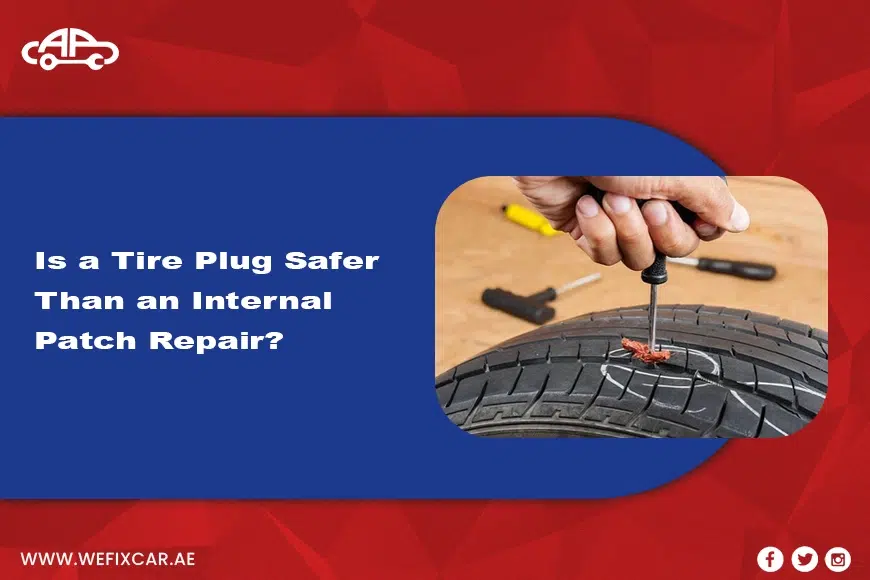
A flat or damaged tire can happen at any time on busy roads in Dubai where drivers regularly deal with sharp objects road debris and long-distance journeys. When you need car puncture repair one of the common questions is whether a tire plug is safer than an internal patch repair. Both methods can repair types of punctures but they are not suitable for every situation. The right choice depends on the punctures location size angle tire condition. Whether the tire has been driven while underinflated.
Understanding Tire Plugs and Internal Patches
A tire plug is a repair material inserted into the puncture from the outside. It is designed to seal the hole and prevent air from escaping. Plug repairs are often associated with roadside or emergency repairs because they can usually be completed without removing the tire from the wheel.
An internal patch repair is different. The tire is removed from the wheel so the inside can be inspected. A patch is then applied to the liner around the damaged area. This allows the technician to examine the tire closely and identify additional damage that may not be visible from the outside.
There is also a repair method commonly called a combination plug-patch where a rubber stem seals the puncture channel while a patch seals the surface. Industry guidance commonly considers a combination repair preferable to simply inserting a plug or applying a patch alone for many repairable punctures.
Is a Tire Plug Safe?
A properly installed tire plug can provide a useful temporary or depending on the repair system and tire manufacturers guidance permanent repair for certain punctures in the tread area. However safety depends heavily on how and where the plug’s installed.
The puncture should generally be small and located within the tread area. A plug should not be used to repair damage in the sidewall or shoulder because these areas experience flexing while the vehicle is moving.
Another important factor is whether the tire was driven for a distance while flat or severely underinflated. Internal damage can occur when the outside of the tire looks acceptable. Simply inserting a plug cannot correct damage inside the tire.
For this reason a plug should not automatically be considered the option simply because it is faster.
How Does an Internal Patch Repair Work?
With an internal patch repair the tire is removed from the wheel. Inspected from the inside. The technician can locate the puncture. Check whether the inner liner sidewall or other components have suffered damage.
The damaged area is prepared before the patch is installed. Proper preparation is important because contamination moisture incorrect preparation or poor application can affect the repairs ability to maintain an airtight seal.
An internal inspection also gives the technician an opportunity to determine whether the tire is actually safe to repair. If the tire has internal damage excessive wear or another condition that makes repair unsuitable replacement may be recommended instead.
Tire Plug vs Internal Patch: Key Differences
The biggest difference between these two approaches is how much of the tire can be inspected during the repair.
A plug can be convenient because the tire may not need to be removed from the wheel. This can make it particularly useful when a driver experiences a puncture away from home or needs assistance.
An internal patch takes time because the tire must be removed and inspected. However the technician gets a better opportunity to assess the condition of the tire before completing the repair.
Here is a simple comparison:
Feature Tire Plug Internal Patch
Tire removal Usually not required Required
Repair speed faster Generally takes longer
Internal inspection Limited Possible
Suitable for sidewall damage No No
Suitable for every puncture No No
Emergency usefulness High Lower
Ability to inspect damage Limited Better
The table shows why neither method should automatically be described as safer in every situation. Tire repair is dependent on the damage.
Read More: Tyre Puncture Repair Guide: Common Causes, Fixes and Safety Tips
When Can a Tire Puncture Be Repaired?
Not every puncture should be repaired. A small puncture in the central tread area may be repairable if the tire is otherwise in condition. A puncture close to the shoulder or in the sidewall is generally considered unsuitable for repair.
The tires overall condition also matters. A technician should consider tread depth age previous repairs signs of overheating damage and whether the tire was driven while severely underinflated.
If a tire has been driven for a distance without adequate pressure internal components can become damaged. In that situation an external plug may hide the problem without addressing the structural condition of the tire.
Why the Puncture Location Matters
The location of the puncture is one of the important factors in determining whether a repair is possible.
The central tread area is typically more suitable for repair than the shoulder or sidewall. The shoulder and sidewall flex considerably as the tire rotates. Carries the vehicles weight. A repair in these areas may not maintain the durability.
For drivers in Dubai this is particularly important because high temperatures and long journeys can put demands on tires. A tire that already has damage should not be returned to service simply because the puncture itself appears small.
What About Combination Repairs?
A combination repair uses both a plug- stem and an internal patch as one repair unit. This approach is designed to seal the puncture channel well as the inner liner.
Professional tire repair procedures often emphasize repairing the puncture from the inside after removing and inspecting the tire. A combination repair can provide a comprehensive seal than relying only on an externally inserted plug.
However even a combination repair is not appropriate when the tire has damage that makes it unsafe to repair.
Can a Plug Be Used as a Permanent Repair?
This depends on the tire manufacturer repair material repair procedure and applicable industry guidance.
Some plug products are marketed for repairs when installed according to specific instructions. Other plug-based solutions may be intended as temporary repairs. Therefore it is important not to assume that every tire plug has the safety characteristics.
A professional technician can assess the tire. Determine whether the particular repair method is appropriate. If there is uncertainty about the tires condition replacing the tire may be safer than attempting a repair.
Dubai Driving Conditions and Tire Repairs
Dubais climate makes tire maintenance especially important. Ambient temperatures can increase tire operating temperatures particularly when a vehicle is driven at highway speeds or carries heavy loads.
This does not mean that every punctured tire requires replacement. It does mean that repairs should be carried out correctly and that tire pressure should be checked regularly.
Drivers should follow the vehicle manufacturers recommended tire pressure than using an arbitrary pressure level. Tire pressure should also be checked when the tires are cold for the accurate reading.
Regular inspection can help identify tread wear cracks bulges embedded objects and other problems before they develop into a serious issue.
Signs That a Punctured Tire Should Be Replaced
There are situations where repairing the tire’s not the appropriate solution. Replacement may be necessary if:
The sidewall is punctured or damaged.
There is shoulder damage.
The tire has structural damage.
The tire has been driven while severely underinflated.
The tire has uneven wear.
There are large cuts bulges or cracks.
The puncture is too large for an approved repair.
The tire has already received excessive repairs.
A professional inspection is important because some of these problems cannot be identified reliably from the outside.
What Should You Do After a Tire Repair?
After a repair the tire should be inflated to the manufacturers recommended pressure. The wheel should be properly. Tightened according to the vehicle manufacturers specifications.
Drivers should also monitor the tire for changes in pressure. If the tire continues losing air after repair it should be inspected again than repeatedly inflated and driven.
If a vehicle has a tire-pressure monitoring system the system should also be checked after the repair. A warning light should never be ignored simply because a puncture has apparently been repaired.
So Which Repair Is Safer?
The answer depends on the condition and location of the puncture. A tire plug can be useful for suitable tread punctures particularly when quick assistance is required. However an external plug does not provide the opportunity for internal inspection as removing the tire.
An internal repair allows a technician to inspect the inside of the tire and determine whether hidden damage exists. For repairable punctures a professionally installed combination repair following proper procedures can provide a more comprehensive repair than simply inserting a plug from the outside.
The important point is that car puncture repair should never be selected based only on speed or price. The tire should first be inspected to determine whether it is repairable and which repair method is appropriate.
Final Thoughts
A tire plug and a patch inside the tire are not the same for every hole. A plug can work for some holes in the tread. An inside check and a good repair can help see how the tire is doing. The safest thing is to get the damaged tire looked at before deciding how to fix it.
For drivers in Dubai picking the fix is just one part of tire safety. Keeping the pressure checking how much the tread is worn, not putting too much weight in the car and replacing tires that are damaged when needed can all help lower the chances of tire problems, on the road.
FAQs About Tire Plug and Patch Repairs
Is a tire plug than an internal patch?
Not necessarily. Safety depends on the punctures size location tire condition and repair procedure. A qualified technician should inspect the tire before deciding which repair is appropriate.
Can a tire plug be used on a sidewall?
A conventional tire plug should not be used to repair sidewall damage. Sidewalls flex while driving making this type of damage unsuitable for normal puncture repair.
Is a patch better for a puncture?
An internal repair provides an opportunity to remove the tire and inspect its condition. For a puncture a properly installed combination repair may provide a more comprehensive repair.
How long can a repaired tire last?
The lifespan of a repaired tire depends on the quality of the repair tire condition puncture location driving conditions and manufacturer recommendations. A repaired tire can continue to be used when the damage was suitable, for repair and the tire remains in good condition.
Can I drive after a tire plug repair?
If a trained professional has done a repair that meets the standards and said the tire is safe then it is usually okay to drive as per the instructions from the repair product and tire company. Do not drive on a tire that keeps losing air.
Should I change a tire of fixing it?
It might be needed if the hole is not in the area that can be fixed if there is damage inside the tire or if the tire is very worn out or has big problems. The best way to know if it can be fixed is to get it checked.
How often should I check my tire pressure in Dubai?
Check the tire pressure often and before trips using the pressure that the car maker says is right. Checking when the tires are cold gives a reading.