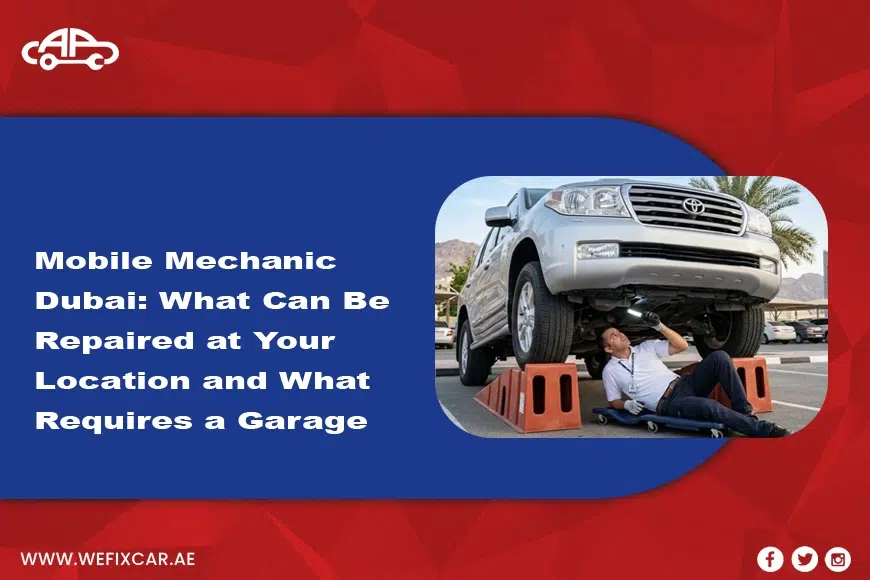
Car trouble in Dubai can happen at the most inconvenient time—outside your home, in an office parking area, or even on the roadside. Fortunately, not every problem means arranging a tow truck and spending hours at a workshop. A mobile car mechanic can come directly to your location, diagnose the issue, and complete many common repairs without requiring you to move the vehicle. Mobile services in Dubai commonly cover diagnostics, batteries, tyres, oil changes, brakes, air conditioning, electrical faults, and selected mechanical repairs.
However, mobile repair has practical limits. Some jobs require a hydraulic lift, engine hoist, specialist machinery, extensive disassembly, or a controlled workshop environment. Knowing the difference can save you time, money, and unnecessary towing.
What Is a Mobile Mechanic in Dubai?
A mobile mechanic is an automotive technician who travels to the vehicle instead of requiring the owner to bring the vehicle to a traditional workshop. Depending on the service provider and the type of fault, the technician may work at your home, workplace, apartment parking area, or a safe roadside location.
The process normally starts with an assessment. You provide the car’s make and model, describe the symptoms, mention any dashboard warning lights, and share your location. The technician can then bring appropriate diagnostic equipment and tools.
For many routine problems, this approach eliminates the need for a garage visit altogether. For more complicated repairs, the technician can determine whether the vehicle needs to be recovered to a workshop.
Repairs That Can Usually Be Done at Your Location
The exact capabilities of a mobile service vary by vehicle, technician, equipment, and working conditions. Nevertheless, several types of repairs are commonly suitable for onsite work.
1. Battery Replacement and Jump Starts
A dead or weak battery is one of the simplest problems to address at your location. A technician can test the battery and charging system, perform a jump-start where appropriate, and replace the battery if it has failed.
Battery replacement is particularly convenient when the vehicle is parked in a basement, residential building, or office car park because there may be no reason to arrange towing.
Some vehicles also require battery registration or electronic configuration after replacement, so the technician should have the appropriate equipment for the specific model.
2. Computer Diagnostics
Modern vehicles rely heavily on electronic control systems. A warning such as the check-engine light, ABS warning, airbag light, or charging-system warning does not necessarily identify the failed component by itself.
A mobile technician can use diagnostic equipment to scan the vehicle, retrieve fault codes, and combine those results with a physical inspection. This can help identify whether the problem is related to a sensor, electrical circuit, engine system, or another component. Dubai mobile repair providers commonly offer onsite diagnostic scanning.
Diagnostics are especially useful when the car still starts and drives but is displaying an unexplained warning.
Read More: Find the Best Car Mechanic Near You in Dubai
3. Oil and Filter Changes
Routine engine oil and oil-filter replacement can generally be performed at a suitable location. The technician can drain the old oil, replace the filter, add the correct oil, and check for leaks.
Dubai’s climate and driving conditions make regular vehicle maintenance particularly important. Following the manufacturer’s recommended service intervals can help reduce unnecessary engine wear.
Because used engine oil must be handled responsibly, the technician should also ensure that waste fluids are collected and disposed of appropriately.
4. Brake Pad and Some Brake Repairs
Brake inspections and certain brake repairs can often be completed onsite. Depending on the vehicle and available equipment, a technician may inspect pads, discs, calipers, and related components and replace worn parts.
Some mobile providers specifically offer brake-pad and disc replacement at the customer’s location.
However, braking problems should never be treated as a minor inconvenience. If the pedal feels unusually soft, the vehicle pulls heavily when braking, or you hear severe grinding, avoid driving the vehicle until a professional has assessed it.
5. Tyre Problems
Flat tyres, punctures, tyre changes, and certain tyre-related problems are often suitable for mobile assistance. A technician can inspect the tyre and determine whether it can safely be repaired or needs replacement.
A mobile service can be especially useful when you have no spare tyre, cannot safely drive to a tyre shop, or are stranded in an inconvenient location.
More specialized tyre services, such as certain alignment or balancing procedures, may require workshop equipment.
6. Minor Electrical Repairs
Electrical faults can range from a simple blown fuse to more complicated wiring or charging-system problems. Mobile technicians can often diagnose and repair relatively accessible electrical issues onsite.
Common examples include problems involving lights, fuses, batteries, sensors, starter systems, and some wiring faults.
If the problem involves extensive wiring, difficult-to-access components, or advanced electronic control-system faults, a workshop may ultimately be necessary.
7. Air-Conditioning Checks and Minor Repairs
A functioning air conditioner is more than a luxury in Dubai. Weak or warm AC can make driving extremely uncomfortable during the hotter months.
Mobile technicians can perform certain AC checks, pressure tests, refrigerant services, and minor repairs at the vehicle’s location. Some providers also offer AC gas recharge and leak diagnosis onsite.
However, major compressor, evaporator, or dashboard-related repairs may require substantially more disassembly and workshop equipment.
8. Minor Mechanical Repairs
Some mechanical issues can be repaired without moving the vehicle. Depending on access and the fault, these can include belts, hoses, certain cooling-system components, spark plugs, ignition coils, and other relatively accessible parts.
The important factor is not simply whether a component can technically be replaced outside a workshop. The technician also needs enough space, suitable tools, safe working conditions, and a stable surface.
Repairs That Usually Require a Garage
A professional mobile technician should not attempt every repair onsite simply for convenience. Some jobs are safer and more practical in a properly equipped workshop.
Major Engine Repairs
Engine rebuilds, cylinder-head work, internal engine repairs, and extensive engine disassembly usually require a workshop.
These jobs may involve an engine hoist, specialized tools, extensive workspace, and procedures that cannot realistically be performed in a residential parking area.
Transmission and Gearbox Repairs
Minor transmission-related diagnostics may be possible onsite, but internal transmission repairs and overhauls generally require workshop facilities.
Automatic transmissions in particular can involve complex internal components that require specialized equipment and controlled working conditions.
Clutch Replacement
A clutch replacement can involve substantial disassembly and often requires the vehicle to be raised securely. A workshop with a suitable lift and transmission-support equipment is generally more appropriate.
Wheel Alignment
Wheel alignment requires specialized alignment equipment to measure and adjust the vehicle accurately. This is a classic example of a service that is better suited to a properly equipped workshop rather than a roadside or home repair.
Extensive Suspension Repairs
A technician may be able to replace certain suspension components onsite, but extensive suspension work can require a lift, specialized tools, and additional inspection equipment.
If several components are damaged or the vehicle has suffered an impact, a workshop assessment is usually the safer option.
Accident and Body Repairs
Dent repair, major bodywork, chassis repair, painting, and collision restoration require facilities that a mobile service vehicle generally cannot provide.
There are also legal considerations around repairing accident-damaged vehicles. UAE traffic legislation states that a vehicle repair centre cannot repair a vehicle showing signs of accident or damage without the required vehicle repair permit from the relevant traffic authority or authorized body.
Major Cooling-System or Structural Repairs
A simple hose or accessible component may be replaceable onsite, but a severely damaged radiator, extensive cooling-system fault, or problem requiring significant disassembly may need a workshop.
If the engine has overheated severely, continuing to drive can potentially cause additional damage. A professional should determine whether the vehicle is safe to move.
How to Know Whether You Need a Mobile Mechanic or Garage
The easiest approach is to describe the symptoms before booking a service.
Tell the technician:
Your vehicle’s make, model, and approximate year
What the car is doing or not doing
Any dashboard warning lights
Whether the engine starts
Any unusual noises, smells, leaks, or vibrations
Your exact Dubai location
Whether the vehicle can be moved safely
A good mobile service should assess the situation before beginning the repair. If the required work needs a lift, engine hoist, specialist machinery, or extensive disassembly, the technician should explain why a workshop is necessary.
Why Choose a Mobile Mechanic in Dubai?
The biggest advantage is convenience. Instead of arranging transportation for a vehicle with a relatively simple fault, you can have a technician come to you.
Mobile repair can also reduce downtime. If your battery fails at home before work or your car develops a minor problem in an office car park, an onsite service may allow you to resolve the issue without spending hours waiting at a workshop.
It can also be useful for vehicles that are difficult or unsafe to drive. A technician can assess the car where it is and determine whether it can be repaired there or needs recovery.
However, convenience should never take priority over safety. If a vehicle has serious brake, steering, engine, transmission, or accident-related problems, professional recovery to an appropriately equipped workshop may be the better choice.
Final Thoughts
A mobile mechanic can handle a surprisingly wide range of car problems in Dubai, from battery replacement and diagnostics to oil changes, tyres, brakes, electrical faults, AC services, and selected mechanical repairs. The key is understanding that mobile repair is designed for jobs that can be completed safely with portable tools and equipment.
Major engine work, internal transmission repairs, clutch replacements, wheel alignment, extensive suspension work, body repairs, and other equipment-intensive jobs are generally better handled at a garage.
When in doubt, describe the problem before booking. A qualified technician can determine whether your vehicle can be repaired where it is or whether it needs workshop facilities. That simple assessment can prevent unnecessary towing while ensuring that complicated repairs are handled safely and correctly.
FAQs
Can a mobile mechanic repair my car at home in Dubai?
Yes. Many common services can be performed at home, including battery replacement, diagnostics, oil changes, tyre assistance, brake work, electrical repairs, and selected mechanical repairs. The vehicle’s condition and the available working space determine what can safely be completed onsite.
Is a mobile mechanic cheaper than a garage?
Not necessarily in every situation. Mobile service can reduce costs associated with towing and may save time, but the price depends on the repair, parts, vehicle, location, and technician. For major repairs, a workshop may be more economical because it already has the required equipment.
Can a mobile mechanic fix a car that won’t start?
Often, yes. The technician can check the battery, starter, charging system, fuel-related symptoms, and electronic fault codes. If the problem is something simple such as a failed battery, the repair may be completed onsite. More serious engine or electrical faults may require workshop recovery.
Can a mobile mechanic replace brake pads in Dubai?
In many cases, yes. Brake pad replacement and certain disc-related repairs can be performed onsite when the vehicle and working conditions allow it.
Can a mobile mechanic repair an engine?
A mobile technician can handle some minor engine-related repairs, such as spark plugs, coils, belts, hoses, and accessible components. Major engine repairs, rebuilds, and internal damage generally require a properly equipped workshop.
What repairs definitely require a garage?
Major engine or transmission work, extensive clutch repairs, wheel alignment, major suspension work, body and accident repairs, painting, and jobs requiring a hydraulic lift or specialist machinery are typical examples.
Can a mobile mechanic service luxury cars in Dubai?
Many Dubai mobile services work on European and luxury vehicles, but capabilities vary by technician and diagnostic equipment. For complex faults, confirm beforehand that the technician has the appropriate diagnostic tools and expertise for your specific make and model.
What should I do if my car is unsafe to drive?
Do not continue driving simply to reach a garage. Move to a safe location if possible, switch on your hazard lights where appropriate, and contact a professional for assessment or recovery. A mobile technician can determine whether an onsite repair is possible or whether the vehicle should be transported to a workshop.